Buyer Guides
Custom Christmas Pajamas: A Production Timeline for Brands
Plan a custom Christmas pajama order backward from your warehouse date, with clear gates for artwork, fabric, sampling, compliance, bulk production and freight.
By PajamaWorks Team, Sleepwear production team, Dongguan Hualingniao Apparel ·

For custom Christmas pajamas, start with the date stock must be received at your warehouse—not the date you want production to begin. Ask your manufacturer to build a project-specific calendar backward through freight, packing, bulk inspection, pre-production approval, sampling, and material approval. There is no responsible universal lead time: print method, fabric, size range, packaging, compliance scope, and the speed of your approvals all change the schedule.
The safest plan is a chain of approval gates with named owners and due dates. If one gate moves, you can immediately see what must change: the launch date, the product specification, or the shipping plan.
1. Define the warehouse date and the launch promise
Your customer-facing launch date is not the same as your inventory-ready date. Work backward from the earliest date on which complete, inspected, saleable units must be available to your fulfillment team.
Before asking for a calendar, write down:
- the destination warehouse and sales market;
- the planned on-sale date and any preorder promise;
- whether stock must be split across more than one destination;
- which adult, child, or pet sizes belong in the matched collection;
- the quantity by style, colorway, artwork, and size;
- the required retail packaging and carton marks; and
- the intended freight mode, with a contingency option to discuss.
Do not convert these into a delivery guarantee yourself. Send them to the manufacturer and freight partner so each can confirm the parts they control. Customs clearance, port conditions, and final-mile appointments sit outside a sewing line, while late artwork approval sits outside a forwarder’s control.
For a seasonal product, also decide what happens if the original date becomes impossible. A smaller launch assortment, fewer print colorways, simpler packaging, or a later non-Christmas position may be commercially better than rushing every variable at once.
2. Freeze the range before the first sample
A quote for “matching family Christmas pajamas” is not yet a production brief. A useful brief identifies every garment that must match and every way it is allowed to differ.
For each style, specify:
- woven or knit construction;
- top and bottom silhouette;
- sleeve and leg length;
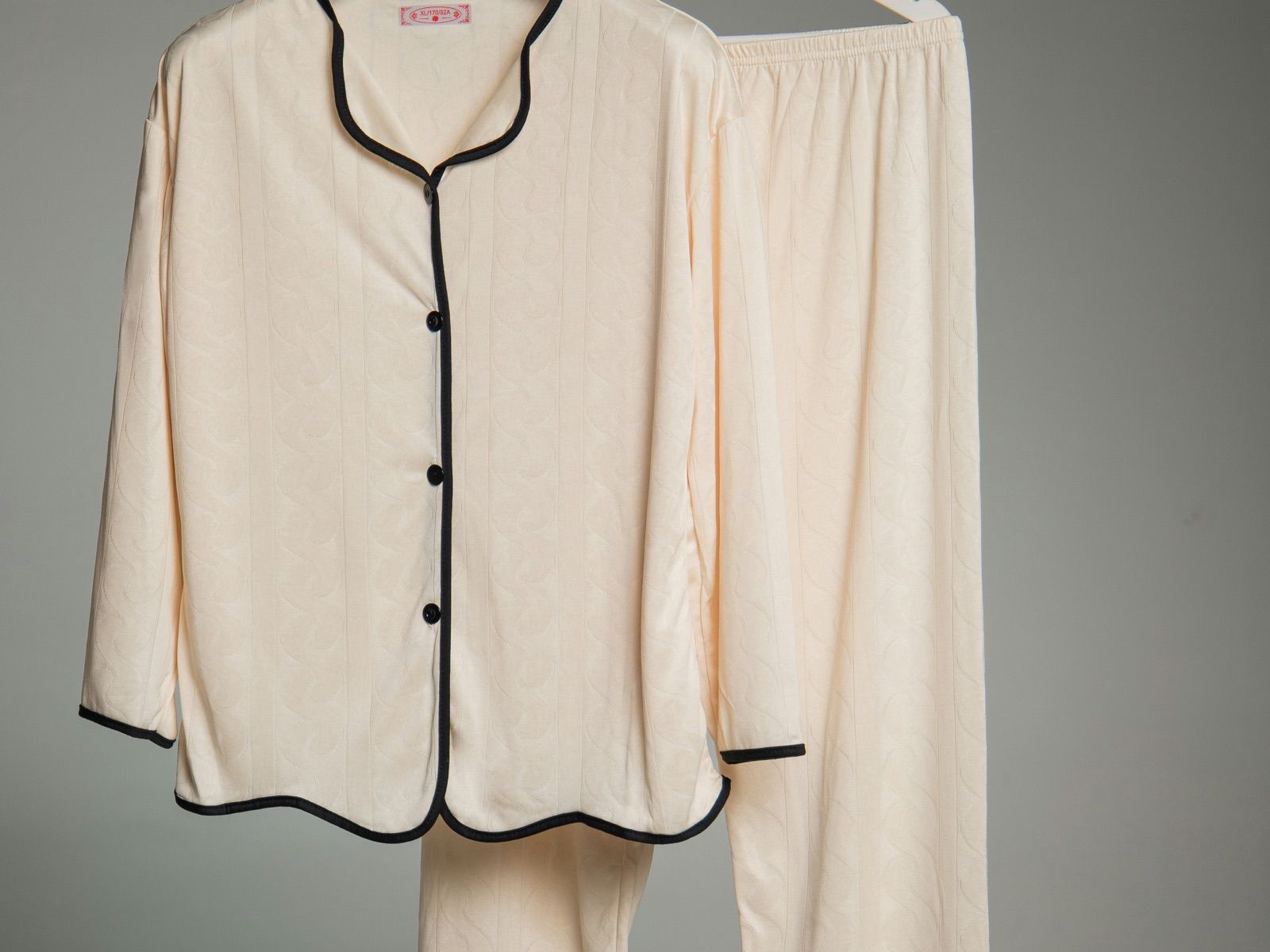
- collar, placket, cuff, pocket, waistband, and drawcord details;
- fabric composition direction, construction, weight, and hand-feel reference;
- print file, repeat size, scale, ground color, and placement rules;
- trim colors and any embroidery;
- size chart, grading basis, and fit model information; and
- main label, size label, care label, hangtag, and packaging artwork.
A coordinated range does not require identical construction. An adult button-up set, a child tight-fitting knit set, and a pet garment may share a print but need separate patterns, measurements, testing decisions, and approval samples.
If your decisions are not yet complete, prepare a pajama tech pack that clearly marks what is fixed and what the factory may propose. An open decision is manageable; an invisible one becomes a revision.
3. Approve fabric and print as separate gates
Christmas artwork often appears simple on screen and changes character when repeated across fabric. Before approving a garment sample, confirm the material and the decoration on the actual substrate.
The material gate should record the approved fiber content, fabric construction, usable width, weight specification, color, hand feel, stretch or recovery where relevant, and any project-specific performance requirements. A photograph cannot confirm these properties.
The artwork gate should include a strike-off or equivalent print trial. Check:
- repeat scale and direction;
- motif spacing at seams and plackets;
- color against an agreed physical or measurable reference;
- white or light details on the selected fabric ground;
- print hand and show-through; and
- how the artwork behaves after the agreed care test.
Ask the factory to identify which changes would trigger a new strike-off. A color correction may be contained within artwork approval; changing fabric construction or print process can alter the result enough to require another physical review. See the printing and embroidery process for the decisions that belong in this gate.
4. Make sampling a controlled approval chain
Sample names vary between factories, but the questions should stay distinct. A practical chain for custom Christmas pajamas is:
- Material swatch and print strike-off: Are the fabric and artwork right?
- Development sample: Is the design and construction right?
- Fit sample in the intended fabric: Does the base size fit after the agreed conditioning or wash process?
- Size set or selected graded sizes: Does the grading work across the important size points?
- Pre-production sample: Are the final fabric, print, trims, labels, construction, and packaging represented together?
- Sealed approval standard: Which physical sample and written comments control bulk production?
The approval record matters as much as the sample. Keep one consolidated comment sheet with dated photos, measurement results, requested changes, and an explicit outcome: approved, approved with correction, or resample required. Conflicting comments in email, chat, and annotated photographs create avoidable uncertainty.
Do not approve only from front-facing photographs. Review the garment inside and out, verify measurements against the specification, and check the washed result when laundering can affect fit or appearance. Our guide to pajama sampling explains what each sample should answer.
5. Treat children’s sleepwear as a separate compliance track
If the range includes children, compliance cannot be copied from the adult set. In the United States, the CPSC distinguishes children’s sleepwear subject to 16 C.F.R. Parts 1615 and 1616 from defined infant and tight-fitting exceptions, which are subject to different requirements. Product design, dimensions, fabric, seams, trims, labeling, testing, certification, and tracking information can all affect the route.
The CPSC also separates fabric production-unit testing, prototype seam and trim testing, and production-garment testing for in-scope children’s sleepwear. A passing fabric result is therefore not the same as an approved finished garment.
Before sampling, have the responsible importer or compliance specialist confirm:
- the intended age and size scope;
- the applicable regulatory route;
- the required garment dimensions and labels;
- the test plan and CPSC-accepted laboratory where required;
- who will issue the Children’s Product Certificate; and
- the tracking-label data that must be retained and printed.
PajamaWorks can build the confirmed requirements into the product specification, but the buyer should not treat a factory sample as legal advice or market authorization. The cost and timing of required testing belong in the calendar before the launch is promised.
6. Lock labels and care instructions before pre-production approval
For most textile products sold in the United States, FTC guidance requires labels to disclose fiber content, country of origin, and the identity of the manufacturer or another responsible business. Clothing also falls under the FTC’s Care Labeling Rule.
That makes label copy an input, not a finishing detail. Confirm the actual material information, responsible business identity, origin wording, care instructions, label placement, and language needs before the pre-production sample is sealed.
Care instructions should be based on a reasonable basis for the finished product, including its fabric, print, trims, and construction. If the shirt and pants are always sold as one set and share the same care method, FTC guidance allows one care label on the major piece; if the pieces require different instructions or may be sold separately, each needs its own care information.
Review label files at full size. A correct sentence that becomes unreadable after weaving or printing is not a usable approval. The labels and packaging process should therefore sit on the same calendar as sampling, not after bulk sewing.
7. Release bulk only against one approved standard
Bulk production should start against a sealed pre-production sample, final specification, approved print reference, approved label files, and purchase-order breakdown that all carry the same revision status.
The control plan should identify checkpoints that matter for the style. For a button-front set, that may include print direction, collar and placket symmetry, piping width, button spacing, pocket placement, waistband construction, garment measurements, and appearance after the agreed wash check. For a knit set, recovery, seam stretch, twisting, and dimensional change may deserve more attention.
Agree on what the factory checks during production and what is reviewed at final inspection. A final inspection can find a repeated problem; it cannot cheaply undo an unapproved print or an incorrect grading rule across the whole order. See PajamaWorks’ quality-control approach for the distinction between material, in-line, measurement, and final checks.
8. Protect the schedule with decision rules
A buffer is useful only when the team knows what consumes it. Put the following rules into the project calendar:
- one named approver for fit, artwork, packaging, and commercial decisions;
- a response deadline for every approval gate;
- the effect of silence—never assume it means approval;
- the last date on which artwork, fabric, trim, or quantity can change without replanning;
- who confirms the freight booking and warehouse appointment; and
- the escalation path when a sample or test fails.
When a gate misses its date, ask for a revised critical path immediately. Avoid recovering time by deleting a sample, test, or inspection without understanding the risk that step controlled. Often the safer recovery is to simplify a variable or split a decision, not to pretend the lost days did not happen.
What to send for a usable Christmas pajama quote
For a project-specific quote and calendar, send:
- the required warehouse-receipt date and destination;
- a tech pack, reference sample, or annotated design brief;
- quantity by style, colorway, artwork, and size;
- fabric and print direction, including artwork files;
- the full size range and target market;
- label and packaging requirements;
- children’s compliance scope, if applicable; and
- which decisions are still open.
MOQ is affected by material, print, color, and size fragmentation, so review how pajama MOQ works before splitting a seasonal range into too many variants.
PajamaWorks develops custom pajama sets from a tech pack, reference garment, or defined brief. Send the information above through the quote form, and we will map the approval gates that apply to your design instead of giving you a generic Christmas deadline.