Buyer Guides
Custom Pajama Pants: Design, Printing and Production Guide
How to specify pajama pants for production: waistband systems, rise and inseam, pocket construction, print behavior across pattern pieces, and a size chart a factory can cut from.
By PajamaWorks Team, Sleepwear production team, Dongguan Hualingniao Apparel ·
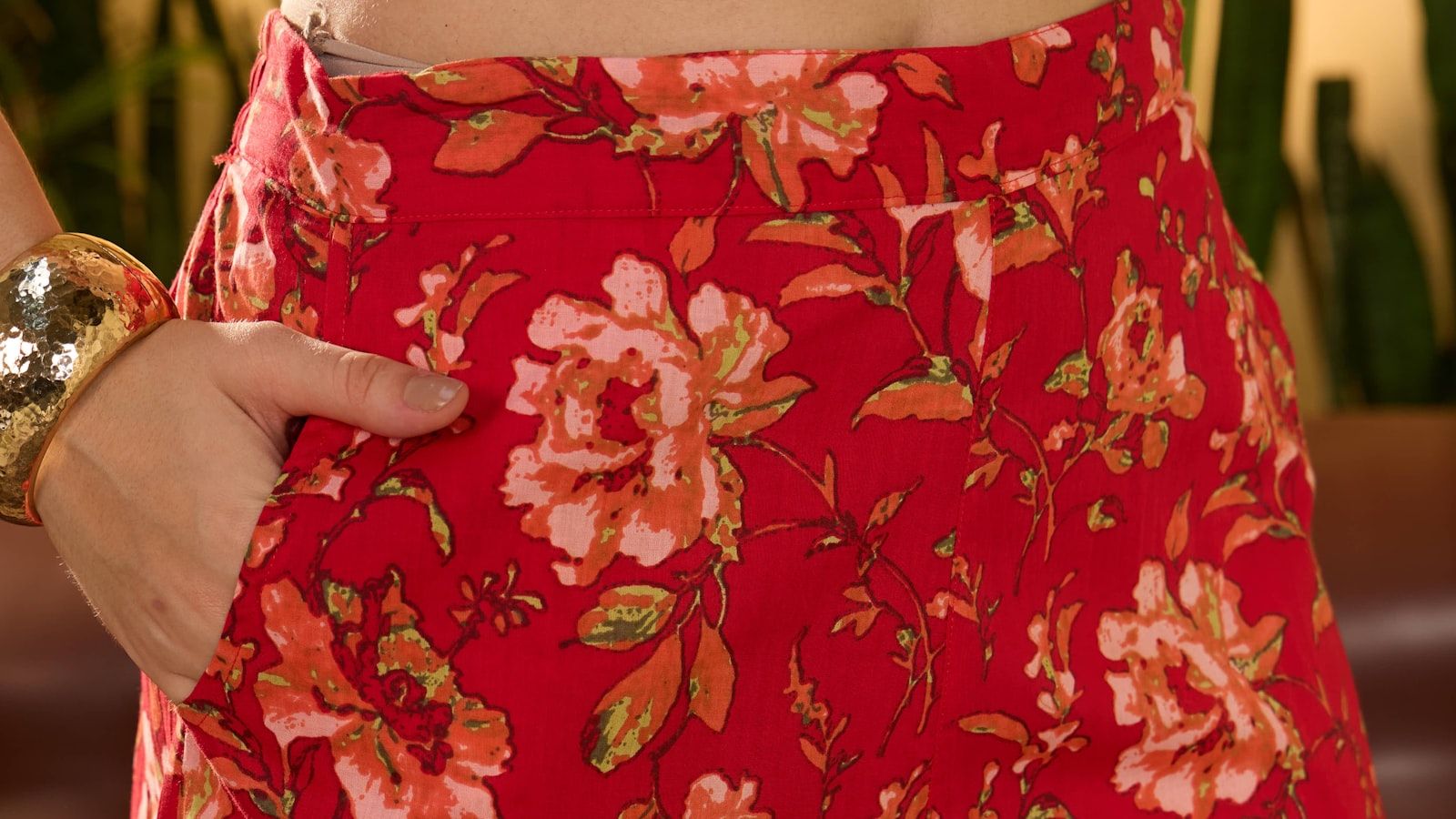
A pajama pant is specified by five decisions: the waistband system, the rise, the pocket type, the finished inseam after laundering, and how the print sits across the pattern pieces. Get those on paper and the rest is ordinary production. Leave any of them to the factory’s judgment and you will re-sample.
Bottoms look like the simplest garment in a sleepwear range. They are the one most often re-sampled, because the decisions that drive the product read like trim details on a tech pack.
The waistband is a system, not a trim
“Elastic waist” is not a specification. It is a family of constructions that cost differently, grade differently, and fail differently.
- Enclosed elastic in a casing. The classic. Fabric folds over the elastic, the elastic floats inside. Comfortable, forgiving on grading, and prone to twisting in the casing unless it is tacked at the seams.
- Exposed elastic. The elastic is the waistband, joined directly to the pant. Cleaner and flatter, often branded with jacquard. Less forgiving: the elastic’s own stretch and recovery become the fit.
- Elastic with a functional drawcord. Two eyelets or a buttonhole opening, a cord that ties. Adds a real adjustment range and adds operations, trims, and a way for the cord to disappear into the casing during laundering.
- Elastic with a decorative drawcord. A cord that is stitched down and does not adjust anything. Cheaper to sew, and honest only if nobody expects it to work.
- Partial elastic — flat front, elasticated back. A more tailored look on a woven bottom, and noticeably more pattern work.
Each choice pulls other specifications with it. Write down the elastic width and type, whether it is enclosed or exposed, how it is joined and secured against roll, cord length and cord tip material, and how the cord is anchored so it cannot be pulled through.
Elastic is also a durability question rather than a fit question. Elastic that measures correctly on the sample and loses recovery after a few washes is the single most common source of bottoms complaints — which is why our men’s sleepwear program treats waistband construction and rise as the whole product on a sleep pant sold as a separate, and checks elastic tension and recovery as a named quality step.
Rise is where the fit actually lives
Most pajama-pant fit complaints arrive worded as “the waist is wrong.” Usually the waist measurement is fine and the rise is not.
Rise is the distance from the crotch seam to the top of the waistband, front and back, and it decides whether the pant sits where the wearer expects when they sit down. Elastic hides a rise error on a hanger and on a standing fit model. It stops hiding it on a sofa.
Specify front rise and back rise separately, along with the crotch curve, thigh, knee and leg opening. Then confirm them on a laundered sample rather than on the first sewn one — our pattern making process launders the fit sample before it reaches you for exactly this reason.
A second rise decision that is easy to miss: how much the back rise grows relative to the front as sizes go up. A flat grade across both looks correct on paper and produces a pant that rides down in the largest sizes. Settle it during size grading, not after the base size is approved.
Pockets change the pattern, not just the look
Pockets are treated as an option and behave like a structural decision.
- Side-seam pockets are the default on sleepwear bottoms. The pocket bag hangs from the side seam, so it is invisible when closed and adds bulk exactly where a lightweight fabric will show it.
- Patch pockets sit on the surface. Cheap, visible, and a print-matching problem on any patterned fabric.
- Slanted or on-seam front pockets read more like ready-to-wear and need a reinforced opening.
- No pockets is a legitimate specification, and worth writing explicitly so the factory does not add them from a reference garment.
Three things to decide alongside the type. Pocket bag fabric — a heavy bag in a light pant drags the side seam and shows through; a self-fabric bag in a dark print can shadow. Pocket opening reinforcement, because the opening is where the garment tears first. And whether the pocket position is graded, since a pocket placed at a fixed measurement from the waistband looks correct at S and low at XXL.
On a printed fabric, add the matching rule: does the patch pocket match the body print, or is the mismatch accepted as part of the look? Both answers are fine. An unwritten answer is not.
Leg length has to survive the wash
The inseam you approve on an unwashed sample is not the inseam the customer measures.
Cotton and cotton-rich wovens move most, and a bottom is the garment where the movement is visible — a shirt that shrinks 3% is slightly shorter, a pant that shrinks 3% is visibly cropped. The mechanism is covered in our guide to why pajamas shrink after washing; the specification consequence is that the finished inseam has to be stated after the agreed care process, with an allowance built into the cut length.
Make the allowance a number, not a hope. AATCC publishes standard test methods for dimensional change after laundering, which turn “it might shrink a bit” into a measured percentage you can grade around and check against in production.
Inseam is also a length class, not one number per size. ASTM International publishes adult male body-measurement tables in short, regular and tall variants, and separate tables for the adult female misses figure. You do not have to adopt them, but the structure is the point: a single inseam across an eight-size run serves the middle of the range and disappoints both ends. Decide early whether you are offering one length, a short/regular/tall split, or a longer inseam intended to be worn stacked.
Finally, specify the hem itself — depth, whether it is a plain turned hem, a cuffed hem, or an elasticated ankle. Each changes both the finished length and the pattern.
Print behaves differently on a pant than on a top
Bottoms are large, mostly uninterrupted panels cut in pairs, which makes them the most exposed garment in a range to print errors.
Decide and write down:
- the repeat size, and the garment size it was designed for;
- motif direction, and whether the print is one-way — a one-way print doubles fabric consumption on a bottom because the pieces can no longer be nested head to toe;
- whether the print matches at the side seam, the inseam, or neither;
- how a stripe or check is aligned, and whether it is cut on grain or deliberately on the bias;
- for placement prints, a position rule per size rather than one measurement for the whole range.
A repeat does not scale with the garment. The same artwork reads correct on an adult leg and oversized on a child’s — the cross-size mechanism is set out in developing matching family and couple pajamas, and if the artwork belongs to someone else, the approval sequence in our licensed character artwork guide applies before any of this is scheduled.
Approve the print physically. A strike-off on the actual fabric shows what a screen never will: how the ground color reads at scale, whether fine lines survive the substrate, and how the print behaves across a seam.
Fabric sets the silhouette before the pattern does
The same pattern in a woven and a knit produces two different pants.
Cotton poplin and yarn-dyed flannel hold the shape you cut — they suit a classic wide leg, a defined waistband, and a crisp hem. Jersey and other knits fall onto the body, forgive fit errors, print easily, and need a different set of ease allowances and seam types.
Weight decides the rest. Too light and a side-seam pocket bag shows through; too heavy and an elasticated waist bunches. Our guide to choosing pajama fabric weight covers how to state GSM so the quote and the sample are talking about the same cloth.
Give fabric direction before pattern drafting, not after. A pattern drafted for a woven and then made up in a knit is wrong in a way that no number of sample rounds will fix.
A size chart a factory can cut from
A size chart that lists waist and hip is a marketing chart. A production chart names measurement points, states how each is measured, and gives a tolerance.
For a pajama bottom, the minimum useful set is:
- waist, relaxed and stretched, measured flat;
- hip, at a stated distance below the waistband;
- front rise and back rise;
- thigh, at a stated distance below the crotch;
- knee;
- leg opening;
- inseam and outseam, after the agreed care process;
- waistband height.
Add the tolerance for each — a ±1 cm tolerance on a leg opening and on a waist are very different commercial risks — and name the base size that gets fitted first. Where the range runs into extended sizes, introduce them at the size-set stage rather than adding them once the base sizes are in bulk; the grade rarely extends cleanly without a fit check.
Everything above belongs in one document. Our guide to preparing a pajama tech pack covers the format, and sample development is where the chart stops being theoretical.
Flammability, labeling and the children’s split
Two compliance points apply to bottoms and are missing from most pajama-pant content.
First, adult sleep pants are general wearing apparel. The CPSC’s Flammable Fabrics Act guidance explains that the Standard for the Flammability of Clothing Textiles, 16 C.F.R. part 1610, provides test methods for clothing textiles, establishes three classes of flammability, and warns against textiles whose burning characteristics are unsuitable for clothing. This is a fabric question, settled when the fabric is chosen — not a finishing step.
Second, children’s sizes are a different regime entirely. Children’s sleepwear falls under 16 C.F.R. Parts 1615 and 1616, with defined infant and tight-fitting products treated differently again. A drawcord decision also cannot be copied down from the adult block: the CPSC’s guidance on drawstrings in children’s upper outerwear covers a different garment category, but it is the clearest illustration that cord details carry rules tied to the garment and the wearer.
Labeling follows how the pant is sold. A bottom sold as its own SKU needs its own fiber content, country of origin, and responsible business identity under FTC textile labeling guidance. FTC guidance on the Care Labeling Rule allows one care label on the major piece of a set that is always sold together and shares one care method — a condition a separately sold bottom breaks by definition. Decide the selling unit before labels and packaging are specified, because it changes the trim list.
What to send for a pajama pants quote
To quote a bottom accurately, we need:
- waistband system, elastic width and type, and whether the drawcord is functional;
- pocket type, bag fabric, and whether the position is graded;
- front and back rise, and the fit intent in a sentence;
- target finished inseam, and whether it is stated before or after laundering;
- length offering — one inseam, or a short/regular/tall split;
- hem type and depth;
- fabric direction or a reference garment, with target GSM;
- artwork with repeat size, direction, and any seam-matching rule;
- size range, base size, measurement points and tolerances;
- whether children’s sizes are in scope;
- selling unit — separate SKU, or half of a set;
- target quantity by style, colorway and size.
PajamaWorks develops sleep bottoms as separates and as part of coordinated pajama sets and loungewear programs, with the pattern and sealed sample retained so a repeat order reproduces the same fit. Send the list above through the quote form and we will come back with the decisions still open, rather than a number built on assumptions.